


How can diversity guide our science and society?
Kyushu U Connect is happy to announce its third annual event, this year with the theme: Diversity. It goes without saying that diversity plays a critical role in every corner of our lives. Kyushu University understands its necessity, as the very first Vision in our Vision 2030 platform is ‘Promote diversity, equity, and inclusion’ in its governance structure. From understanding different cultures, to interacting with people of different backgrounds, to the biodiversity of nature, diversity gives all of us the necessary insights into what it is to be human.
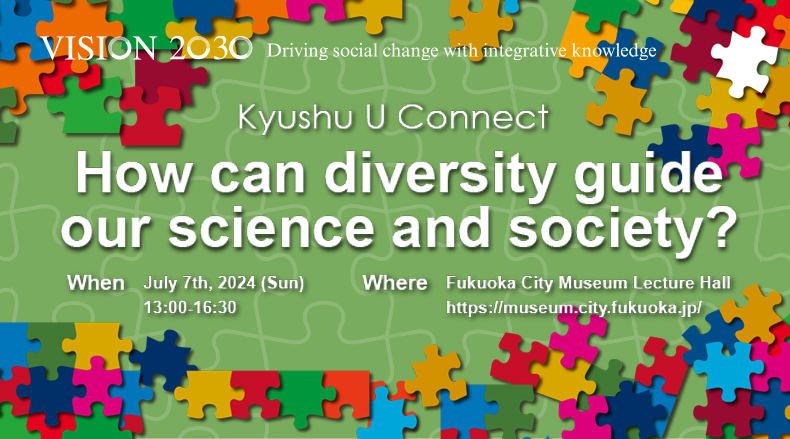
This event will ask you “How can diversity guide our science and society?” We will cover the numerous aspects of how diversity affects our lives from social and gender diversity, biodiversity, intercultural diversity, and its role in medicine. Join us for an afternoon of stimulating talks and discussions facilitated by Kyushu U faculty, students, and science communicators. Let us explore life’s infinite diversity in infinite combinations.
Target
General, High school students, Elementary and junior high school students, Current students and staff
Language
Full bilingual event
Dates
2024.07.07 [Sun] 13:00 – 16:30
Venue name
Fukuoka City Museum
Venue address
3-1-1, Momochihama, Sawara-ku, Fukuoka ★MAP
Seating capacity
120 people, in order of arrival *On the day registration is available if the maximum participants are not reached
Participation fee
Free of charge
Event Details
≪Schedule≫
Each talk is 15 min followed by 10 min Q&A
12:00-13:00 Venue Open
13:00-13:10 Opening remarks
13:10-13:35 Specially Appointed Researcher Noriko Seguchi (Eng)
13:35-14:00 Professor Mikita Suyama (Jpn)
14:00-14:10 Break
14:10-14:35 Associate Professor Hiroko Kinoshita (Jpn)
14:35-15:00 Student Theater Group “Italento”
15:00-16:00 Free roaming group discussion
16:00-16:20 Closing remarks
≪Presenters≫
“The Problem of the Concept of Race and Racism in Japan”
Specially Appointed Researcher Noriko Seguchi (Faculty of Social and Cultural Studies)
Since the 17th century, the diversity of human beings has been simplified into racial categories based on skin color and other physical characteristics. However, it is important to note that the concept of race has no biological basis and is rather a social construct. The concept of race has been used to justify colonialism and slavery, and racial discrimination continues to persist in the present day. The concept of race has also been accepted and used in Japan, particularly in the media. However, discussions about racism are not common in Japan. It is crucial to acknowledge and address the existence of racism.
“Human Diversity from a Genomic Perspective”
Professor Mikita Suyama (Research Center for Systems Immunology, Medical Institute of Bioregulation)
As the phrase “the apple doesn’t fall far from the tree” suggests, children resemble their parents. This is because they are genetically similar. On the other hand, if we look around the world, we see a variety of people with different skin tones, eye colors, and hair textures. Today, we can easily examine the genome– the complete set of human genetic information–for every individual. Let’s think about the human diversity and diseases that genomes can tell us.
“Towards Religious Diversity and Multiculturalism”
Associate Professor Hiroko Kinoshita (The International Student Center)
It is estimated that by 2050, the world’s Muslim population will account for approximately 30% of the world’s total population. Many Muslims are expected to come to Japan in the future, making Japanese society increasingly diverse. How can people of different faiths live together? Let’s learn together how to understand religious diversity for multiculturalism.
“Biodiversity and Us: Insect Lives Matter”
Student Theater Group “Italento”
Our planet is rich in biodiversity. Insects are an especially diverse group, accounting for more than 50% of all known species on Earth. Insects are hard workers, some are pollinators, others are protectors of agriculture, decomposers of poop and human waste, etc. Insects are essential to our lives. But have we ever appreciated their hard work? How significantly would our daily lives change if there were no insects? Today, we will try to see the life of our “daily neighbors.”
≪MC≫
Professor Natalie Konomi
(Global Strategies Office)
≪Moderator≫
Professor Johan Lauwereyns
(Faculty of Arts and Science)
Registration method
Advanced registration required
[Online]
https://forms.office.com/r/XyDSgA94G8
Registration period
2024.06.04[Tue]–2024.07.04[Thu]
Inquiries
Name: Kyushu University Public Relations Office
TEL: 092-802-2131
Mail: sysintlkh★jimu.kyushu-u.ac.jp
Please replace ★ with @
Address: 744 Motooka, Nishi-ku, Fukuoka
[Website]
https://forms.office.com/r/XyDSgA94G8